
Trading Plastic for Stone Indoor vs. Outdoor Climbing:
Some things to keep in mind when climbing outside the first time.
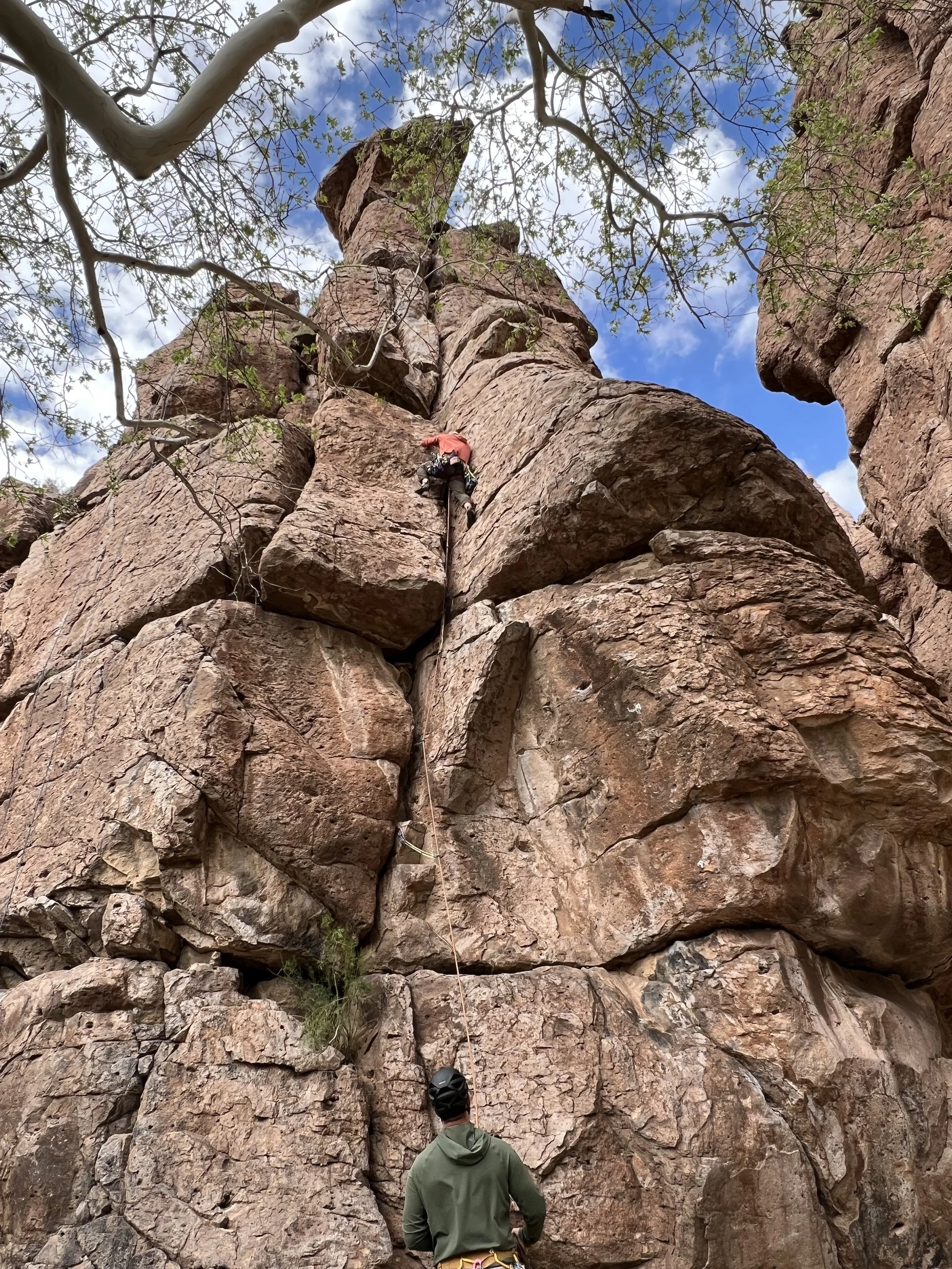
You've been climbing in the gym for eight months. You've got decent footwork, some hip mobility, and a little bit of gear. Then you go outside, and you spend forty minutes failing on something the guidebook calls a 5.7. Now you’re sitting in the dirt wondering if you've been lied to your entire climbing life. You haven’t been…well, kinda.
Indoor and outdoor climbing are cousins, not twins. Same family. Different personalities. One of them is polite and the other one doesn’t care about you at all.
The grades are not the same (usually).
Let's get this out of the way. Gym routes are graded harder than they would translate outside on purpose. Why? Well, there is a commercial interest in you feeling good about your session: It keeps you coming back to the gym. That isn’t a bad thing though. Feeling good about your climbing is an important component of progress. However, that interest doesn’t translate to a rock feature that hasn’t moved in 200,000 years.
Outdoor route developers don’t care about you feeling good about your climbing. They care about grading their routes accurately. Expect to drop grades outside. Typically, at least a full number grade. This is normal. The gym didn't lie to you it just grades on a slightly different scale. Accept that your outdoor grade and your indoor grade are two separate numbers. Track them separately. Compare them to nothing.
Holds don't announce themselves.
This is the real gap. In the gym, the route is color-coded. The holds are obvious, textured, and pointed in a helpful direction. Someone has already solved the problem and painted the answer on the wall.
On rock, nothing is marked. The hold might be a subtle in-cut you can only see from three feet left. The correct foot hold might be a smear on a patch of texture that looks identical to the rest of the wall. Route reading outside is an art and the only way to get better at it is mileage. On top of that you are battling the elements. Going from an air-conditioned gym to climbing on a windy day while having to look up into the sun in search for holds is going to take some getting used to.
Outdoor climbing eats skin.
Plastic is engineered for repeated human contact. Granite, sandstone, and limestone are not. Sharp crystals, coarse texture, and jagged cracks can burn through skin in a fraction of the time it would take in a gym. And when the skin's gone, the day's over, no matter how good you feel.
The systems are the same until they aren't.
Aside from the grades and rock texture, bouldering inside and outside is fairly similar. Leading outside compared to the gym on the other hand is drastically different and there is a lot more that goes into it.
Outside there's no floor padding, staff, or quality control. Bolts vary in age, distance, and quality. There are various anchor systems that need to be set up and cleaned, both of which have deadly failure modes. Graduating from indoor to outdoor lead climbing has a learning curve with severe consequences. Take a class, hire a guide, and practice on the ground before launching up your first outdoor lead.
Set your expectations fairly.
The gym is efficient by design: warm up, climb, leave. Outside, you have to hike in, find the crag, find the route, discover you’re in the wrong place, find the right place, then climb a few routes before the sun comes around the corner forcing you to move. In short, every aspect of climbing outside takes longer than it would inside. If you go out expecting a gym session's volume, you'll come home disappointed. Go outside expecting to have fun with your friends in a cool place and you’ll never come home sulking.
Leave it better than you found it.
We all share the space and there is no one around to clean up after you the way there is in a gym. Also, climbing areas get closed all the time and it’s typically not related to climbing but to destroying the area. To us, crags are sacred so treat them as such. Stay on established trails. Pack out everything, micro-trash and fruit peels. Keep the noise to a reasonable level, if you are bringing a dog (prefer you wouldn’t unless they are uber chill) keep them under control, and follow local closures. And for god’s sake don’t bring a speaker. Remember access is a privilege, not a right.
What to actually expect on day one.
You'll feel weak. You'll feel like a beginner again. Something you'd flash indoors will shut you down completely, and someone twice your age in twenty-year-old shoes will do it without breaking a sweat.
Stay with it. Have fun. Remember climbing isn’t about grades, it’s about doing cool stuff in cool places with cool people. When you return to the gym after a few good days outside you’ll realize that climbing inside on plastic is the worst form of the sport.
Climbing is inherently dangerous. Climb at your own risk. But have fun if you do.